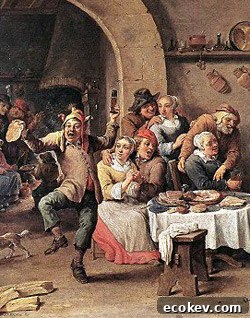
The celebration of Twelfth Night—the traditional final day of the Christmas season—was once observed with far greater revelry than it is today. Historically, the evening of January 5th was often a livelier occasion than Christmas itself, celebrated with feasting, drinking and particular rituals. Food and drink like lambswool traditionally accompanied the festivities, and two special cakes—the King and Queen cakes—were central to the night’s customs. In Britain these cakes evolved into dense, spiced fruit cakes similar to Christmas cakes, commemorating the Magi who came from the East and the Christian feast of Epiphany on January 6th. In France a comparable custom survives as the galette des rois, a light pastry tart filled with almond paste.
The King & Queen Cake: In Britain it was customary to hide “favours” inside the cakes—often a dried pea and a dried bean or small shaped tokens. Two cakes would be prepared: one containing a bean and crowned the King’s cake, the other containing a pea and crowned the Queen’s cake. The person who found the bean in their slice became “King” for the evening; the person who found the pea became “Queen.” The crowned pair led the evening’s games and judged the festivities. This playful reversal of social roles—where hosts or high-ranking people could be mocked and servants briefly elevated—reflects the ancient custom of “misrule,” a tradition found in Britain and Ireland and rooted in pre-Christian seasonal celebrations.

’12th-Night, The King Drinks’ (c.1600s)
‘Twelfth Night: Or King and Queen’, By Robert Herrick (1648)
Now, now the mirth comes
With the cake full of plums,
Where bean’s the king of the sport here;
Beside we must know,
The pea also
Must revel, as queen, in the court here.Begin then to choose,
This night as ye use,
Who shall for the present delight here,
Be a king by the lot,
And who shall not
Be Twelfth-day queen for the night here.The figure of the Lord of Misrule embodies this temporary inversion of social order. For one night the high and mighty might be made to serve while commoners were elevated, part of a long tradition reaching back to pre-Christian seasonal rites such as Samhain.
Note: The 1864 recipe for a traditional Twelfth Night cake yields a very large cake; it is straightforward but extensive. Below we provide an adapted, smaller recipe that is easier to follow. If you wish to prepare both a King and a Queen cake, bake two cakes following the directions. Alternatively, bake a single cake and place a bean in one half and a pea in the other, topping the cake with two crowns.
12th Night King & Queen Cake (Adapted Recipe)
Recipe Ingredients:
- 350 g butter
- 350 g caster sugar
- 6 eggs, beaten
- 75 ml brandy
- 350 g plain flour
- 1 tsp ground allspice
- 1 tsp ground ginger
- 1 tsp ground coriander
- 1 tsp ground cinnamon
- 700 g mixed dried fruit
- 50 g blanched almonds, chopped
- Optional: a pea and a bean as favours
For the decoration
- 45 g apricot conserve or apricot jam (warmed)
- 700 g ready-made marzipan
- 700 g ready-made royal or fondant icing
- Gold crowns for decoration (bought or handmade)
Recipe Method
Cream the butter and sugar together until light and fluffy. Gradually add the beaten eggs, mixing well after each addition, then stir in the brandy. Fold in the flour, spices, dried fruit and chopped almonds. Grease a deep 25 cm cake tin and line the bottom and sides with greaseproof paper. Spoon the mixture into the tin and tap gently to remove trapped air. If desired, add the traditional favours (a pea and a bean) or small coins, placing them separately if making a King and Queen cake.
Preheat the oven to 150°C and bake for approximately 2½ hours, or until the cake is firm to the touch. If the top browns too quickly, cover it with folded greaseproof paper partway through baking. When done, cool the cake in its tin for 30 minutes, then turn it out onto a wire rack to cool completely. The cooled cake can be stored in an airtight tin until ready to decorate.
Brush the top with warmed apricot preserve to help the marzipan adhere. Roll the marzipan to about 5 mm thick and cut a disc to cover the cake’s top, pressing it gently into the jam. Allow the cake to rest; it can be left covered for several days to mature. When ready to finish, brush the marzipan with more apricot jam, roll out the fondant or royal icing to roughly 5 mm, cut a disc to fit and place it over the marzipan. Leave the cake to set for an hour, then cover and store. Allow the cake to mature in a tin overnight or up to two weeks before serving. Finish by decorating with small gilded crowns and pipe any additional decorations if desired. Serve slices with traditional Twelfth Night drinks such as lambswool.
_________________________________________________________________
12th Night Cake (1864 Recipe)
Recipe Ingredients
- Butter – 2 lb 12 oz (approx. 1,200 g)
- Sugar – 1 lb 12 oz (approx. 750 g)
- Currants – 5 lb (approx. 2,200 g)
- Citron peel (or mixed orange and lemon peel) – 1½ lb (approx. 680 g)
- Almonds – 6 oz (approx. 170 g)
- Spices (nutmeg, mace, cinnamon) – total 2 oz (approx. 57 g), powdered
- Eggs – 20
- Brandy – ½ pint (approx. 250 ml)
These proportions produce a richly fruited and iced cake. If you prefer a sweeter cake, increase the sugar to equal the butter by weight; the recipe uses a bit less sugar to balance the large quantity of fruit. More almonds may be added to taste.
Recipe Method
Warm a large, smooth pan and soften the butter to a fine cream by working it with your hand or a spoon; in warm weather this can be done without heating the pan. Add the sugar and beat until pale and light. Break in two or three eggs at a time, mixing thoroughly before adding more, and continue until all eggs are incorporated and the mixture feels light. Stir in the brandy, currants, peel, spices and almonds—some of these may be sliced or cut into small pieces beforehand—then fold in the flour lightly.
Place the mixture into a well-lined hoop or large cake tin. For very large cakes, line the sides with multiple layers of stiff paper and consider placing a buttered paper or tin tube in the centre to allow the middle to bake evenly. Support the baking tins on a tray layered with sawdust or fine ashes to protect the base and bake at a moderate temperature. Baking time will vary with oven conditions and cake size.
When the cake is cold, proceed to ice it. Traditionally, almond icing is applied first on the top; once dry, the top and sides are covered with white royal icing. While the icing is wet, attach gum-paste ornaments or other decorations. When dry, add piped details, orange blossoms, ribbons or small sugar knobs for a finished appearance.
Icing
Twelfth Night cakes are finished with white or colored icing and decorated with gum paste ornaments, piped designs and other sugar embellishments.
Ingredients & Method for Royal Icing
Sift treble-refined sugar through a fine sieve into a clean, grease-free earthen pan. For each pound (approx. 450 g) of sifted sugar, add the whites of three eggs, or enough to reach a moderate paste consistency. Beat thoroughly with a wooden spoon or spatula, adding a little lemon juice occasionally to give the icing a slight acidity and prevent it from scaling off the cake. Add more egg white if needed, but avoid making the icing too thin. When well beaten, the icing should increase noticeably in bulk and be light enough to cling to the spoon and pan sides.