By Kevin Williams
Monday is often the most common laundry day in many Amish communities. After a weekend of worship and family gatherings, Sunday clothes are usually in need of cleaning, so Monday becomes a practical choice. That said, there is no single day universally observed across all settlements. Weather plays a large role in scheduling laundry. Sunny, breezy days are preferred because they dry clothes faster and more thoroughly, while rainy or humid conditions push laundry chores to a different day.
Watching laundry drying on lines provides a quiet, revealing portrait of daily life. The colors, fabrics, and arrangement of garments tell you something about the particular settlement or district. For example, Holmes County, Ohio, is known for brighter colors—sometimes including reds—fluttering in the breeze. In contrast, more conservative Swartzentruber communities favor darker, more muted tones. In the Berne, Indiana area you will often notice rich, royal blues, while Lancaster County, Pennsylvania displays a lot of hunter greens and deep blues. These regional differences come from tradition, community norms, and the practical choices families make about clothing.
The photographs here capture scenes of laundry drying at an Amish home in Wayne County, Indiana. Some heavier, darker items hang on the beautiful front porch, where the shelter and airflow help them dry without direct sun fading. Lighter linens and undergarments are on the outdoor lines, catching the breeze and sunlight. When photographing such private, everyday moments I always ask permission first—it’s important to respect people’s privacy and customs.
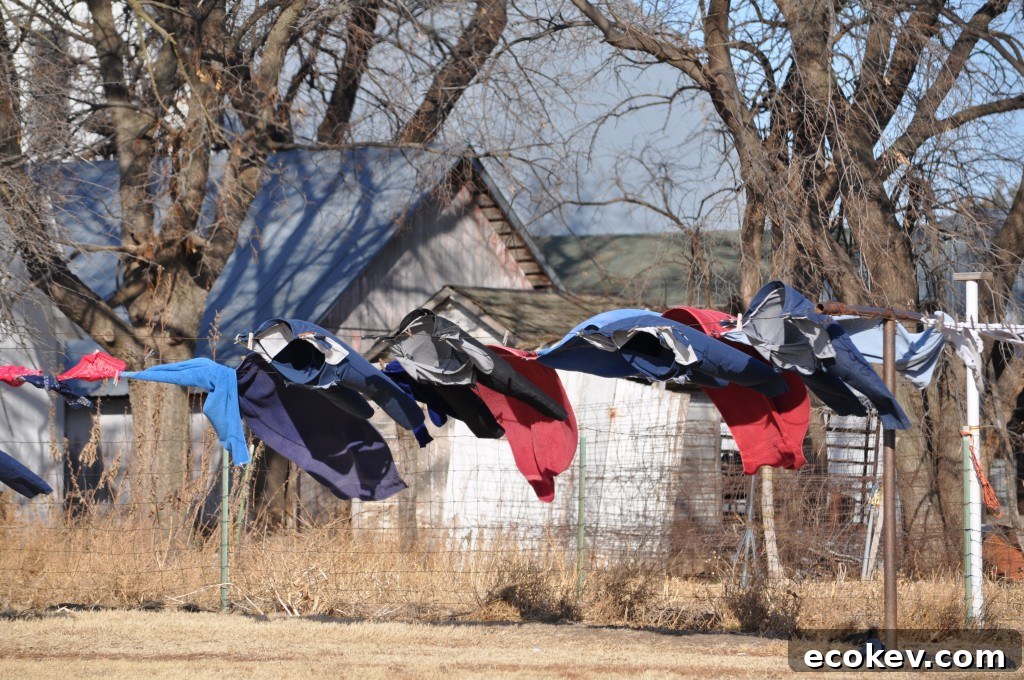
To add visual variety, the top image shows laundry drying in the Amish settlement of Partridge, Kansas. The differences in setting and color across these images reflect both individual household choices and the broader stylistic tendencies of their communities. Whether on a farmhouse porch, stretched across a backyard line, or strung between posts in a yard, laundry scenes reveal practical rhythms of life: the cadence of household tasks, the influence of weather, and a preference for simple, time-honored methods over modern appliances.
Laundry on the line in a Kansas Amish settlement.
Beyond color and placement, laundry lines hint at other aspects of Amish life: resourcefulness, thrift, and care for garments. Hang-drying conserves energy, reduces wear from machines, and often leaves linens smelling fresher. Lines, clothespins, and porch setups are tailored to each household’s needs—long lines for large families, sheltered spots for delicate fabrics, and strategic placement to catch prevailing winds. Small details, like the order of items or how tightly garments are pinned, reflect habit and practicality.
Although many Amish households maintain traditional practices, there is variation in methods and materials. Some families use wooden clothespins and simple rope lines; others may use more modern materials while still avoiding electricity-driven dryers. The balance between tradition and practicality is evident in everyday chores like laundry, where choices are guided by faith, community norms, and the local environment.
In the end, a line of drying clothes is more than a chore in progress—it’s a quiet, visual record of a community’s rhythms. Whether you see bold blues, deep greens, or subdued browns, the sight of laundry swaying in the wind captures a small, honest part of daily life in Amish America.